eseq user manual
Step sequencer
The step grid is the fastest way to build rhythms. Each row is a track; each lit cell is a note.
Steps

- Click an empty step to add a note.
- Click an active step to select it. Double-click to remove it.
- Shift-click selects a range. Command-click adds or removes single steps.
- Drag across empty steps to paint notes. Drag an active step to move it.
- Backspace or Delete removes the selected steps.
With the keyboard: Left and Right move the cursor, Return toggles the step, Up and Down change track. With steps selected, Left and Right shift them instead. Shift with the arrows extends the selection.
Step parameters
The inspector edits the selected steps.
- Transpose shifts pitch from the track's base note.
- Velocity sets strength.
- Duration sets note length.
- Pan places the step in stereo.
- Retrig repeats the note inside the step; Rate sets the spacing.
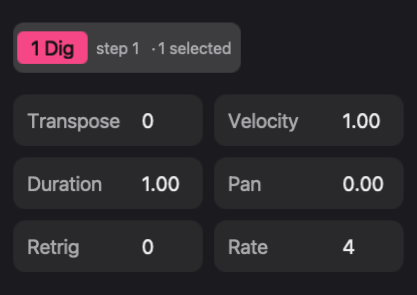
Try it: select every other hi-hat, lower the velocity, then give the last snare a retrig.
Expand a track for parameter lanes and more room. Use the Piano roll for chords and precise lengths.
Expanded track
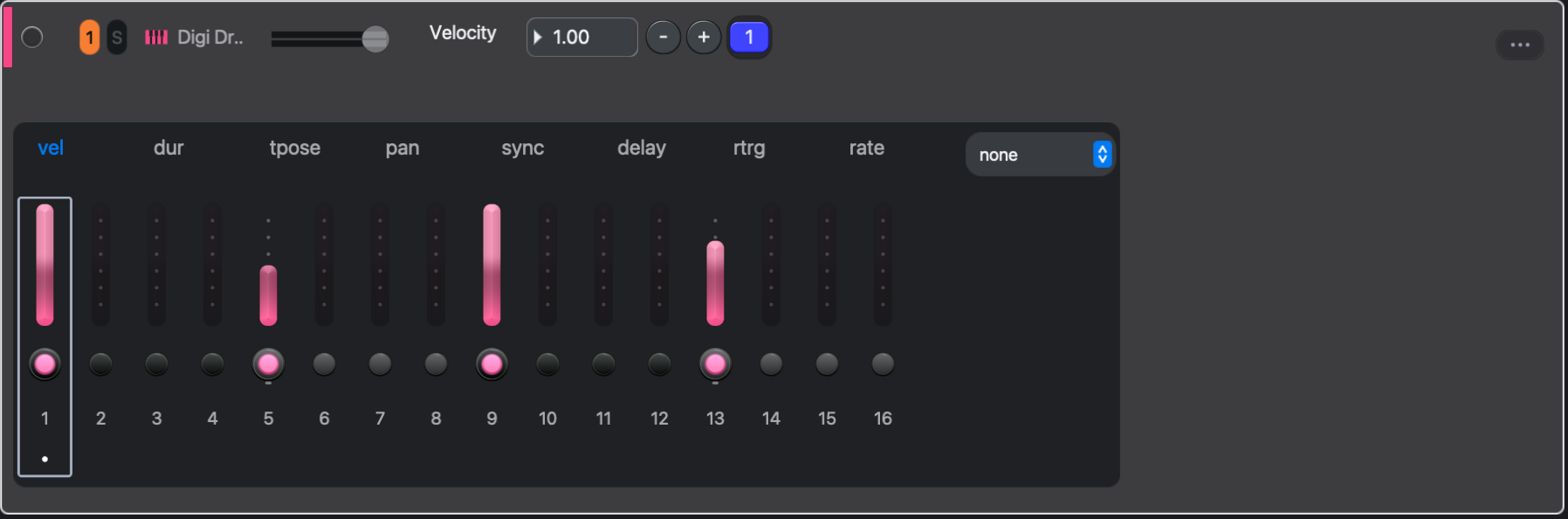
Expanding a track turns its row into a lane editor: one slider per step for the parameter chosen on the tabs above the grid, with the step toggles and numbers underneath.
- Click a tab (vel, dur, tpose, pan, sync, delay, rtrg, rate) to choose the lane. The dropdown at the end of the tabs opens a process lane instead; see Process lanes.
- Drag a slider to set that step. With steps selected, dragging a selected step sets all of them.
- The number picker in the track header edits the cursor step, or every selected step when there is a selection. Type digits while the row has focus to enter a value, Return commits, Escape cancels. When another number picker has focus, typing goes there instead.
- Left and Right move the cursor along the row; the picker follows.
Lanes draw in the track colour. A process lane draws in amber and adds a strip of its own controls to the right of the grid.
Length and timing
Track settings hold the timing controls.
- Steps sets the pattern length. Long patterns span several pages.
- Timebase sets how much time one step takes. Sixteen steps is one bar only at the default timebase.
- Swing delays alternate subdivisions; swing resolution picks which subdivision.
- Poly, voices, priority, and trig decide how overlapping notes behave. Give chords enough voices; let a mono bass overlap and glide.
Tracks can have different lengths. Their patterns drift against each other on each repeat, which is a good way to make a short loop feel longer.
Base value or p-lock
With steps selected, turning a synth or effect knob locks that value onto those steps. With nothing selected, it changes the pattern's base value. Read the selected count in the inspector before you turn a knob. See Parameter locks.
Variations
In the mixer, select a track's pattern cell and press Command-D to duplicate the pattern. Edit the copy. The transport's scene + duplicates the whole scene instead. See Patterns and scenes.